From reactive repairs to predictive maintenance: Discover how IoT and AI-driven motor protection systems are transforming industrial reliability and driving ESG sustainability.
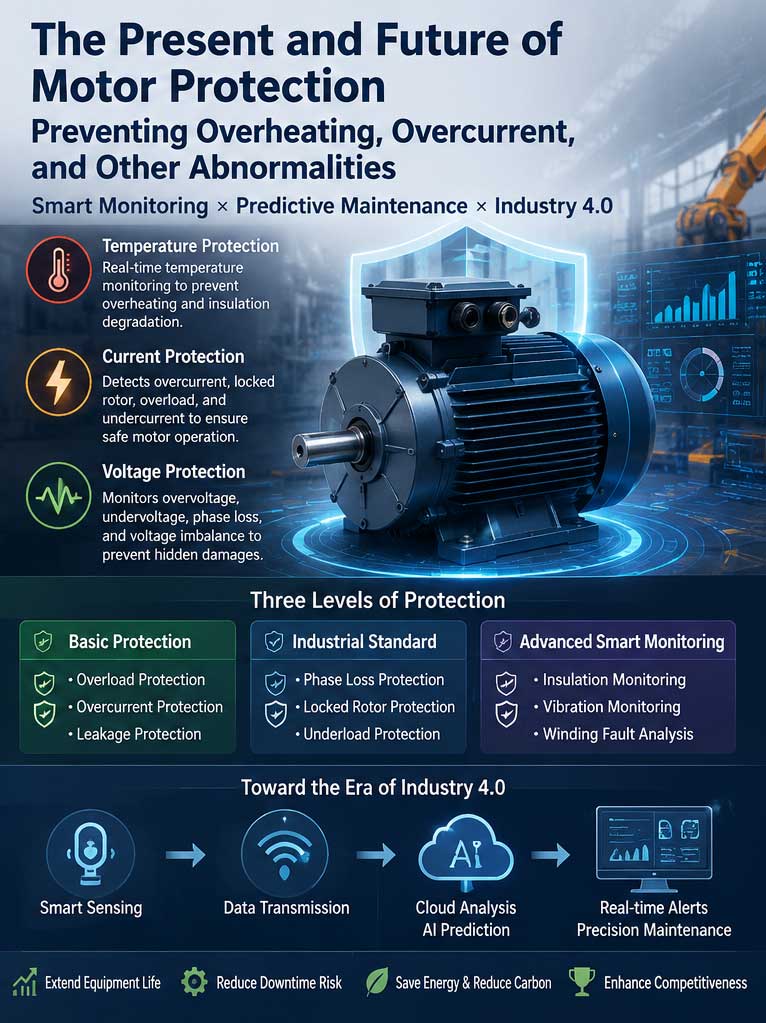
In modern industrial environments, motors are the beating heart of nearly every automated system. From CNC machinery and conveyor belts to industrial pumps and HVAC systems, your production line's stability relies entirely on motor performance.
However, the traditional "run-to-failure" approach is no longer viable. A single unexpected motor burnout can halt an entire production line, resulting in thousands of dollars in lost revenue per hour. Smart motor protection is the definitive answer to this challenge, shifting the paradigm from reactive troubleshooting to proactive predictive maintenance.
The Three Hidden Killers of Industrial Motors
Most motor failures do not happen overnight. They are usually the result of prolonged exposure to specific stressors. Understanding these risks is the first step toward effective protection.
1. Thermal Overload: The Silent Destroyer
During operation, electrical current flowing through motor windings naturally generates heat. However, heavy loads, poor ventilation, or bearing wear can cause internal temperatures to spike rapidly. If the temperature exceeds the insulation class limits, it leads to rapid insulation degradation, short circuits, and ultimately, catastrophic motor burnout.
Modern BLDC (Brushless DC) and industrial inverter motors combat this by integrating PTC/NTC thermistors and thermal switches. When abnormal temperatures are detected, the intelligent controller immediately initiates current limiting or a safe shutdown sequence.
From Diagnosis to Prevention: Building a Total Protection System
"Understanding why a motor heats up is the foundation; smart protection is the future. Combine your knowledge of thermal management with our latest AI-driven predictive insights by accessing this technical resource: [View Our Detailed Motor Overheating Analysis] ]."
2. Current Abnormalities: Overcurrent and Undercurrent
Current fluctuations are immediate indicators of mechanical distress.
Overcurrent: Often caused by mechanical jamming, locked rotor conditions, or severe overload. Without rapid intervention, excessive current can melt motor windings within seconds.
Undercurrent: Frequently overlooked, undercurrent indicates a loss of load. In fluid systems, this points to dry-running pumps, which can cause severe mechanical damage due to a lack of fluid cooling and lubrication.
Intelligent protection systems continuously monitor these parameters, providing instant stall protection and locked-rotor safeguards.
3. Voltage Instability: The Efficiency Drain
Undervoltage is a pervasive issue in heavy industrial settings. When supply voltage drops, a motor must draw higher current to maintain its required output power. This compensatory action leads to increased copper loss, elevated winding temperatures, and significantly reduced operational lifespan.
To mitigate this, modern systems mandate Phase Loss Protection and voltage imbalance monitoring, particularly crucial for three-phase industrial motors.
The Evolution: Traditional vs. Smart Motor Protection
The transition to Industry 4.0 demands more than just basic circuit breakers. Here is how smart protection systems outperform traditional methods:
| Feature |
Traditional Protection |
Smart Motor Protection (Industry 4.0) |
| Core Strategy |
Reactive (Trips after a fault occurs) |
Proactive (Predicts and prevents faults) |
| Monitoring Parameters | Basic Current / Voltage | Current, Voltage, Temperature, Vibration, Harmonics |
| Data Logging | None or minimal | Continuous cloud-based data logging & IoT connectivity |
| Downtime Impact | High (Unplanned outages) | Minimal (Scheduled maintenance based on data) |
| Root Cause Analysis | Difficult (Requires manual inspection) | Instant (AI-driven diagnostics pinpoint the issue) |
Driving ESG Goals Through Predictive Maintenance
Smart motor protection is not merely an operational upgrade; it is a strategic asset for corporate sustainability.
Modern industries are under increasing pressure to meet strict ESG (Environmental, Social, and Governance) targets. By utilizing continuous IoT monitoring, motors are kept operating within their optimal efficiency curves. This precise control significantly reduces unnecessary energy consumption, minimizing both iron loss and copper loss.
The result? Extended equipment lifecycles, lower operational energy costs, and a measurable reduction in the factory's carbon footprint.
Conclusion: Motors That Predict Their Own Future
The future of industrial competitiveness relies on stable operations and minimal downtime. The era of waiting for a motor to smoke before taking action is over.
By upgrading to smart motor protection systems, facilities transform their power devices into intelligent, self-monitoring assets. This predictive approach ensures greater reliability, slashes maintenance costs, and secures your competitive edge in the era of smart manufacturing.
Frequently Asked Questions (FAQ)
Q: What is the main difference between standard overload relays and smart motor protection?
A: Standard relays only react to overcurrent after it happens. Smart protection uses IoT sensors to monitor temperature, vibration, and current trends, predicting failures before they cause damage.
Q: Can smart motor protection really save energy?
A: Yes. By ensuring the motor operates at peak efficiency and preventing conditions like phase imbalance (which forces the motor to work harder), smart systems reduce wasted energy and lower electricity costs.
Q: Is it difficult to integrate smart protection into existing older motors?
A: Not necessarily. Many modern smart protection relays and external IoT sensors can be retrofitted to existing motor control centers (MCCs) without needing to replace the motor itself.