In today’s global economy, industries are simultaneously facing inflationary pressure, rising energy costs, and accelerating ESG regulations. In this environment, efficiency has become the most critical competitive factor.
For decades, traditional AC induction motors have dominated industrial machinery and household applications due to their low cost, mature technology, and durability. However, the global landscape is shifting rapidly.
Companies are no longer asking “How cheap is it to buy?”
They are asking “How much does it cost to operate over the next 5–10 years?”
This shift is driving the rapid adoption of Brushless DC Motors (BLDC motors) worldwide.
1. Inflation and Raw Material Surge: The End of the Low-CAPEX Advantage
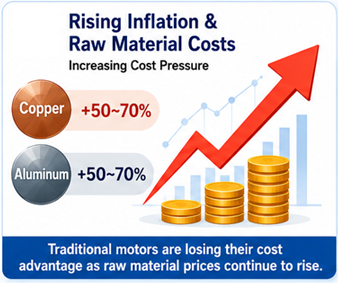
Global geopolitical tensions, energy instability, and supply chain restructuring have led to continuous increases in raw material prices. Since 2025, copper and aluminum prices have risen by 50%–70%+, directly impacting motor manufacturing costs.
Because traditional AC induction motors rely heavily on copper windings and aluminum components, their cost structure is highly sensitive to material inflation. At the same time, the market is rediscovering a classic economic concept: The “Boot Theory” — cheap products often cost more in the long run due to frequent replacement and maintenance.
Low-cost equipment often comes with hidden expenses:
- Higher energy consumption
- More frequent maintenance
- Increased downtime
- Shorter product lifecycle
- Higher noise and thermal losses
As a result, global procurement strategies are shifting from CAPEX-driven thinking to Total Cost of Ownership (TCO) evaluation.
2. Global Energy Regulations: Industrial Motor Efficiency is No Longer Optional
Beyond inflation, global energy policies are accelerating industrial transformation. Major markets including Europe, the United States, China, and Asia are tightening energy efficiency regulations such as:
- IE3 / IE4 high-efficiency motor standards
- HVAC energy efficiency regulations
- Industrial energy-saving policies
- ESG carbon reduction requirements
- Scope 2 emissions targets
Since approximately 70% of industrial electricity consumption is driven by motor systems, improving motor efficiency has become one of the most effective paths toward global decarbonization. At the same time, with the rapid growth of AI computing infrastructure, energy efficiency has evolved from an environmental goal into a strategic industrial resource.
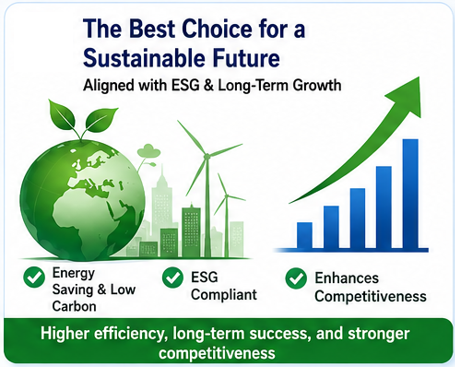
3. Why BLDC Motors Are Gaining Rapid Adoption in Modern Manufacturing
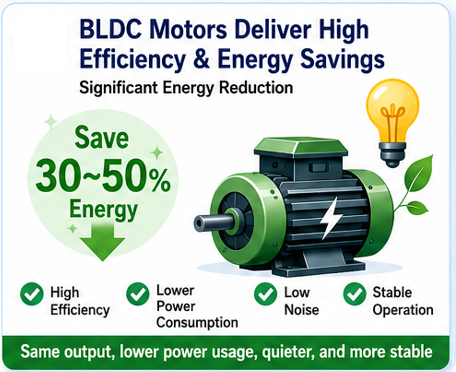
The core advantage of BLDC motors is simple: They are significantly more energy efficient. Through electronic commutation and precise control, BLDC motors achieve:
- 30%–50% energy savings in many applications
- Lower heat generation
- Reduced noise levels
- Higher operational efficiency
- More precise speed control
- Smooth and controlled startup
- Higher power density in smaller size
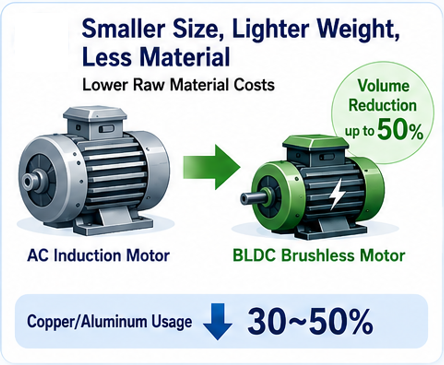
In equivalent power output, BLDC motors can reduce physical size by approximately 50%, while also reducing copper and aluminum usage by 30%–50%. As raw material costs continue to rise, BLDC motors gain additional cost advantages, while traditional motors lose pricing competitiveness. The market trend is clear: the price gap between BLDC and AC motors is narrowing, while the performance gap continues to widen.
4. Hidden TCO Traps of High-Power Induction Motors
Traditional AC induction motors, especially in high-power applications—such as heavy-duty air compressors, mixers, and industrial ventilation systems—contain several hidden cost factors that are often underestimated.
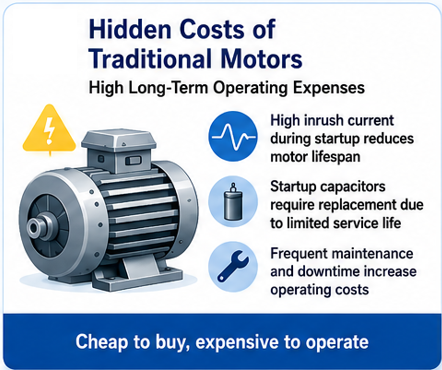
1. Starting Capacitor Dependency & Inrush Current Single-phase or high-power induction motors typically require large starting capacitors and generate high inrush current during startup. When used in heavy machinery like band saw machines or drilling machines, this leads to:
- Insulation aging of windings
- Increased thermal stress
- Bearing load stress
- System-level electrical impact
2. Limited Lifespan of Capacitors in High-Cycle Applications Starting capacitors are consumable components with limited switching cycles and operational lifespan. In custom factory automation equipment that requires frequent start/stop cycling, these capacitors demand:
- Periodic replacement
- Maintenance downtime
- Spare part inventory cost
3. Frequent Start/Stop Stress In applications with frequent cycling, these effects are significantly amplified, increasing long-term operational cost and failure risk. As labor, energy, and maintenance costs rise globally, companies are increasingly recognizing that the real cost of a machine is not the purchase price — but the total cost over its entire lifecycle.
📊 Industrial TCO Comparison: Traditional AC vs. Yen Shen BLDC Motors
| Evaluation Metric |
Traditional AC Induction Motor |
Yen Shen BLDC Motor Solution | Long-Term Enterprise Value |
| Energy Efficiency |
High consumption; substantial thermal losses. |
30%–50% electricity savings; cool operation. | Slashes operational expenses & Scope 2 carbon footprint. |
| Maintenance & Lifespan | High downtime risk due to capacitor/bearing wear. | Capacitor-less, brushless digital commutation. | Minimizes unplanned factory downtime and labor costs. |
| Physical Footprint | Bulky, heavy, and highly sensitive to raw material inflation. | 50% smaller size; 30%–50% less copper/aluminum usage. | Facilitates compact machinery design and optimizes space. |
| Smart System Readiness | Limited to basic, single-speed mechanical operation. | Native digital control architecture for real-time data. | Serves as an ideal intelligent actuator for AIoT ecosystems. |
5. BLDC and Smart Control: Future-Proofing for the AIoT Era
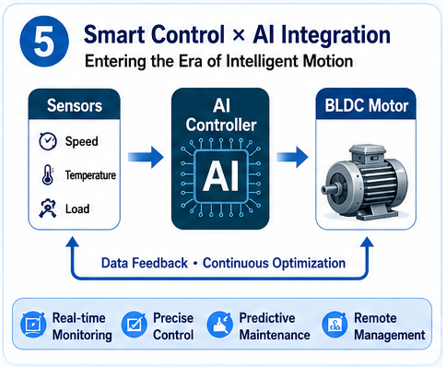
One of the most important advantages of BLDC motors is their native digital control architecture, which makes them highly compatible with AI and IoT systems.
- Ideal Actuator for AI Systems In modern AI architecture, BLDC motors serve as real-time motion actuators, load-adaptive control units, remote-controlled devices, and energy-optimized execution nodes.
- Data-Driven Operation BLDC systems can provide real-time operational data such as speed, load conditions, temperature, and efficiency curves. This enables motors to become data-generating assets, not just mechanical components.
- Closed-Loop Intelligent Systems Future industrial systems will operate in closed-loop architecture: Sensors → AI decision-making → BLDC execution → feedback optimization. This transforms motors into intelligent motion nodes within AI-driven systems.
6. Yen Shen Electric: From Motor Manufacturer to Smart Motion Solutions Provider
With nearly half a century of experience in motor technology, Yen Shen Electric continues to focus on high-efficiency BLDC motor development and system-level energy solutions.
We believe: Every unit of electricity saved today becomes long-term financial value tomorrow. Therefore, we are not only providing motors — we are delivering complete efficiency solutions:
- Energy optimization and system-level efficiency design
- Reduced maintenance cost and improved operational stability
- ESG compliance support and long-term competitiveness enhancement
Our BLDC technologies are widely applied in:
- Industrial fans & ventilation systems
- Air compressors & pumps
- Band saw machines, mixers, & drilling machines
- Automation equipment
Through customized engineering, we help customers build next-generation high-efficiency systems.
7. Conclusion: Efficiency Is the New Industrial Language
In a world shaped by inflation, energy transition, and AI acceleration, industrial competition is being fundamentally redefined.
The critical decision is no longer merely about mitigating immediate upfront expenses. Forward-thinking enterprises are now evaluating a much more vital metric: “How much cumulative value and strategic advantage will this motion system unlock for our operations over the next decade?”
BLDC motors sit at the absolute center of this industrial transformation. In the coming years, high-efficiency motors will no longer be an upgrade option — they will become the baseline standard.
Yen Shen Electric will continue investing in high-efficiency motor technology, intelligent control integration, and green energy applications to help global customers build more energy-efficient, quieter, and smarter motion solutions. Because the most valuable solution is not the cheapest one — but the one that continuously saves energy, reduces cost, and strengthens competitiveness over time.
🔍 Industry FAQ: High-Efficiency BLDC Motors
Q1: What is the typical ROI period when replacing traditional AC induction motors with BLDC motors?
A: While BLDC motors have a higher initial CAPEX due to advanced electronic controllers, they typically achieve a full Return on Investment (ROI) within 12 to 24 months purely through 30%–50% energy savings and eliminated maintenance costs (such as capacitor failures) in high-duty cycle applications.
Q2: Can Yen Shen Electric’s BLDC motors be customized for existing legacy industrial machinery?
A: Yes. Yen Shen Electric specializes in custom engineering solutions. We design BLDC motors with customized mounting flanges, shaft dimensions, and tailored digital control interfaces to directly replace legacy AC induction motors in machinery like band saws, mixers, and pumps without requiring a complete system overhaul.
Q3: How do BLDC motors assist companies in meeting ESG Scope 2 emissions targets?
A: Scope 2 emissions refer to indirect greenhouse gas emissions from purchased electricity. Since motor systems consume the vast majority of industrial power, switching to Yen Shen’s energy-saving BLDC motors directly lowers your factory’s megawatt-hour consumption, immediately reducing your audited carbon footprint and helping fulfill corporate ESG mandates.