BLDC Motor Applications and Basic Selection
For readers who are new to BLDC motors, this article introduces the key benefits, suitable applications, and basic motor-structure choices.
When selecting a motor, one of the first questions people ask is: "Is a BLDC motor better than a conventional motor?" The simple answer is that no single motor is best for every product. The value of a BLDC motor depends on how well it matches the machine's real operating conditions.
BLDC motors can provide high efficiency, no brush wear, and flexible speed or torque control. However, the final performance still depends on how well the motor, driver, load, cooling, and operating environment work together.
One key idea to remember is that a BLDC motor is not automatically better. Some applications simply allow its advantages to create more value.
1. What Are the Main Advantages of BLDC Motors?
BLDC stands for Brushless DC Motor. The main difference from a brushed DC motor is that current switching is handled electronically by a driver instead of by brushes and a commutator.
- Higher efficiency can be especially valuable in long-running equipment.
- No brushes to wear out means fewer routine maintenance requirements.
- Electronic control makes speed, torque, and position control easier to implement.
- The motor can be customized to meet specific size, speed, and torque requirements.
- With the right system design, the motor can help reduce size and simplify the machine.
Important: The benefits of BLDC do not come from the motor alone. The driver, sensor, load, and cooling design all affect the final result.
2. Continuous Operation: Small Efficiency Gains Add Up
If a machine runs for only a few minutes per day, a small efficiency difference may not matter much. But when equipment operates for 8, 16, or even 24 hours a day, the difference in energy use and heat generation can become more important.
Typical applications include ventilation and HVAC equipment, industrial conveyors, cooling fans, air-filtration systems, and other continuous-duty machinery.
Simple rule: The longer the equipment runs, the more important energy savings and lower heat generation can become.
3. Battery-Powered Equipment: Efficiency Can Mean Longer Runtime
In battery-powered products, motor efficiency can directly affect runtime. If two motors perform the same job but one uses less energy, it may run longer from the same battery capacity, assuming the rest of the system and operating conditions are comparable.
- Drones and mobile equipment
- Automated guided vehicles (AGVs) and autonomous mobile robots (AMRs)
- Cordless power tools
- Light electric mobility
- Other battery-powered industrial equipment
For battery products, the better question is not only "How many watts is the motor?" but "How much energy does the complete motor-and-driver system need to do the job?"
4. Low Noise, Reduced Brush-Related Maintenance, and Potential Service-Life Benefits
Because BLDC motors do not use sliding brushes and a commutator, they can reduce brush-related friction, wear, carbon dust, and some sources of operating noise. This makes them attractive for air purifiers, fans, appliances, and selected precision equipment.
However, "brushless" does not automatically mean the entire machine will be quiet. Noise can also come from bearings, fan blades, driver switching, torque ripple, and mechanical resonance.
The absence of brush wear can reduce one source of maintenance, but overall service life still depends on bearings, insulation, thermal conditions, load, speed, environment, and the quality of the complete design.
Selection tip: If noise is important, define the acceptable dB level together with the motor speed, measurement distance, and test conditions.
5. Low-Speed, High-Torque Operation: A Chance to Simplify the Drivetrain
Many conventional machines use a high-speed motor and then reduce speed and increase torque through belts, pulleys, or gearboxes.
AC Motor → Belt / Pulley → Gearbox → Machine
If a BLDC motor is designed around the actual low-speed and torque requirements of the machine, some applications may allow a simpler drivetrain or even a direct-drive configuration.
BLDC Motor + Driver → Machine
In suitable applications, this may reduce component count, maintenance requirements, and installation space. But direct drive is not simply a matter of removing the gearbox. Engineers still need to verify continuous torque, peak torque, startup load, speed range, and thermal performance.
6. Precision Control: Selecting the Right Feedback Method
Some machines only need the motor to rotate. Others require constant speed, stable low-speed operation, or even repeatable stopping at the same position. In these cases, a BLDC motor combined with a driver and feedback device offers greater control flexibility.
- Hall sensor: suitable for basic commutation and general speed control.
- Encoder: suitable for higher-resolution speed or position feedback when the application requires it.
- Sensorless control: reduces sensors and wiring, but low-speed and startup conditions need special attention.
This article focuses on the basics. A companion article will explore Hall sensors, encoders, sensorless control, and FOC in greater detail.
7. Inner Rotor vs. Outer Rotor: Where Is the Rotor?
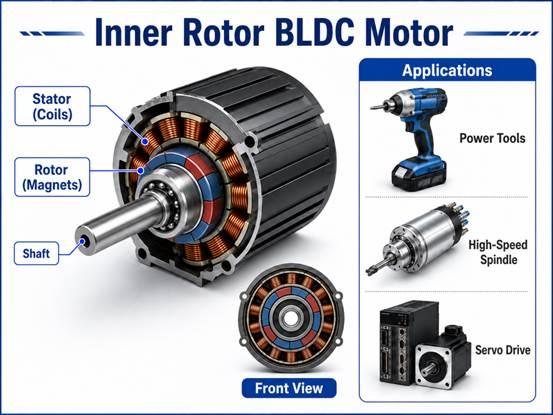
Inner Rotor
In an inner-rotor motor, the rotor rotates inside the stator. Because the rotating mass is generally closer to the shaft, rotor inertia can be lower, making this structure well suited to high-speed operation, rapid acceleration and deceleration, or frequent reversing.
Figure 1. Inner Rotor BLDC: commonly used in power tools, high-speed spindles, and applications that require fast dynamic response.
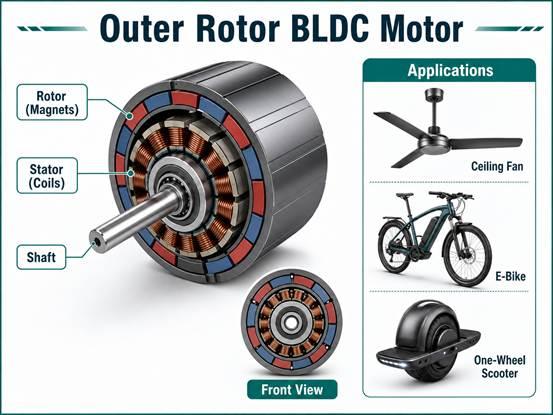
Outer Rotor
In an outer-rotor motor, the rotor surrounds the stator. The larger effective radius can support higher torque in certain designs, so this structure is common in fans, hub drives, and low-speed, high-torque applications.
Figure 2. Outer Rotor BLDC: commonly used in fans, hub drives, and low-speed, high-torque applications.
An easy way to remember it: inner-rotor designs are often well suited to high-speed operation and fast dynamic response, while outer-rotor designs can be advantageous in lower-speed, higher-torque applications. This is a starting point, not an absolute rule.
8. Radial Flux vs. Axial Flux: Understanding Flux Direction
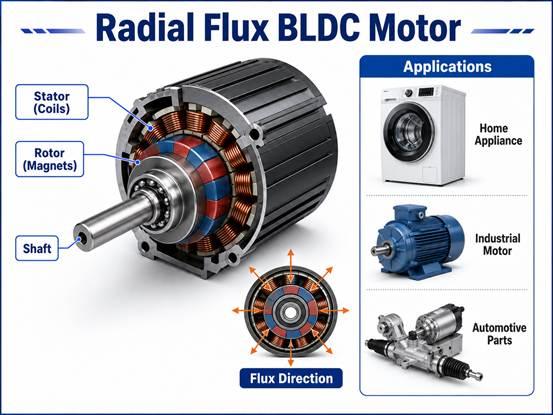
Radial Flux
Radial-flux motors are a mature and widely used motor architecture. Their magnetic flux is primarily oriented in the radial direction. Manufacturing processes are well established, and the design can be adapted to many power levels and package sizes.
Figure 3. Radial Flux BLDC: widely used in appliances, industrial motors, and automotive components.
Axial Flux
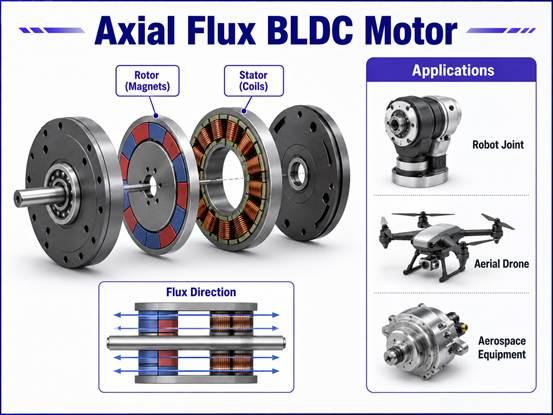
In an axial-flux motor, the magnetic flux acts mainly along the shaft direction. This architecture can enable a shorter axial package and, in some designs, higher torque density, making it worth considering for flat package spaces or special mechanical layouts.
Axial flux is not automatically more advanced or better. It can also introduce new challenges in manufacturing, cooling, structural design, and mass production.
Figure 4. Axial Flux BLDC: can be considered when axial space is limited or high torque density is required.
Quick BLDC Selection Guide for Beginners
| My Requirement |
Possible Starting Point |
What Else to Verify |
| Long operating hours, energy saving |
High-efficiency BLDC + suitable driver |
System efficiency, heat generation, and duty cycle |
| Battery powered | High-efficiency, compact BLDC | Runtime, torque, speed, and cooling |
| Low noise, low maintenance | BLDC with a suitable low-noise driver | Bearings, fan/blade noise, switching noise, and mechanical resonance |
| High speed, fast response | Inner Rotor | Rotor inertia, load inertia, and mechanical strength |
| Low speed, high torque | Outer Rotor or another high-torque architecture | Continuous torque, peak torque, and cooling |
| Precise speed or position | Closed-loop BLDC + Encoder | Feedback resolution, accuracy, and response time |
| General mass production | Consider radial-flux BLDC | Manufacturing maturity, cost, and scalability |
| Limited axial space | Consider axial flux | Manufacturing, cooling, and structural integration |
Conclusion: Do Not Look for the "Best BLDC" - Look for the Best Fit for the Application
When selecting a BLDC motor, the most important question is not wattage alone. Start with the machine's real operating conditions: How much torque is required? What is the speed range? Will it run continuously? How often will it start, stop, or reverse? How precise must the control be? What space and cooling conditions are available?
The right BLDC solution starts with the machine's actual operating conditions. By considering torque, speed, duty cycle, control, installation space, and cooling together, engineers can determine whether BLDC is a suitable fit for the application.
For real-world examples of how customized BLDC motors address application-specific challenges across different industries, see BLDC Motor Applications Across Industries: How Customization Solves Real-World Performance Challenges.
Yen Shen Engineering | Customized BLDC Motor Solutions